Evidence-based therapy
Which approach is right for me?
While these approaches may all sound different, they share a lot of overlap in the ways they produce change, something you notice when you know them very well.
You don't need to know anything about these before coming in. If something resonates with you, feel free to bring it in.
So which approach is right for me? Above any individual modality, the research keeps finding that the biggest factor in whether therapy helps isn't the type of therapy used, it's the relationship shared with the therapist: feeling safe, understood, and that you're working with someone who gets you.
In practice, Sarsha works integratively, drawing from different approaches depending on what's happening for you.
This isn't an exhaustive list of therapy approaches, just the ones Sarsha predominantly draws from.
Schema Therapy
Sometimes we notice the same patterns showing up in our lives again and again. It might be that we always put others first. That we pull away when people get too close. That we feel guilty when we do something for ourselves. A belief that whatever we do, we're not enough, no matter how much we try.
These patterns often have roots in our early experiences. The messages we heard from the world around us, about who we are, what we deserve, how much space we're allowed to take up, gradually become the messages we play to ourselves. Over time, they stop feeling like something we were taught. They start feeling like the truth.
Schema Therapy is a way of exploring those deeper patterns together. We look at where they came from, and especially at how they're showing up in your life right now. At your own pace, we begin to find new ways of responding, ones that feel more like you, and less like old survival strategies you no longer need.
Something to consider…
Schema Therapy is generally a longer term approach. While elements of this work can be woven into shorter term therapy, it often takes upwards of 10 sessions.
Cognitive Behavioural Therapy (CBT)
CBT is built on the idea that our thoughts, feelings, and behaviours are all connected, and that changing one can ripple through the others.
In CBT, we slow down and get curious about those connections. We look at the stories we tell ourselves and ask whether they are accurate, helpful, or just very familiar. Then, together, we practise small, concrete shifts, in how we think and what we do, that gradually change how we feel. Because the three are linked, a change in any one of these, whichever feels most workable, will tend to pull the other two.
Dialectical Behaviour Therapy (DBT)
DBT is built on combining two things that might sound like opposites: acceptance and change. The idea is that in order to change something, we often have to accept it first. It is not that we agree with it. Sometimes we just have to acknowledge that this is where we are right now.
This is what the word dialectical points to: the idea that two things can be true at the same time.
Both things true, at once. DBT helps us sit with that tension rather than collapse into it or oscillate between both, because it is often where real change begins.
“When I accept myself just as I am, then I can change.”— Carl Rogers
DBT can also focus on building different skills, depending on what's actually needed. This could be areas like mindfulness, distress tolerance, emotion regulation, or interpersonal effectiveness. That can look like learning how to move through big emotions rather than being consumed by them, or learning how to ask for what you need in ways that actually land with the people around you.
Acceptance and Commitment Therapy (ACT)
Out there in the world, we tend to get a pretty consistent message: we should feel good, be happy, and avoid bad feelings. That life, if we are doing it right, should be making us happy. Over time, this gives us the sense that we should be able to control how we feel. And so we try.
And this does work, but only for a while.
Because trying to push away an uncomfortable feeling is a bit like pushing a beach ball underwater. You can hold it down for a moment, but it will always bounce straight back up.
ACT takes a different approach. Rather than trying to change what we feel, we learn to change our relationship with what we feel. This means making space for difficult thoughts and emotions, not because we like them or agree with them, but because when we stop fighting them, then something shifts.
ACT calls this defusion: becoming unstuck from our thoughts rather than being swept away by them. Imagine standing on a footpath watching cars go by. Each car is a thought. Some are loud, some speed past, some slow right down and seem to follow you. Defusion is the practice of staying on the footpath. You notice the cars. You do not have to jump in.
ACT has multiple different parts. Another one of those is getting clear on our values. Values are different to goals. They are not things we can achieve in a set amount of time and then tick off. They are ways we want to be: kind, adventurous, fun, compassionate. You can never fully achieve a value, but you can always keep striving towards it. When we get clearer on these, they act as a compass. They do not make the hard feelings disappear, but they give us a direction to move toward even when things are difficult.
This can feel quite different to an approach like CBT. Rather than trying to think our way through something, ACT invites us to step back from our thoughts entirely, to hold them a little more lightly, and to keep moving in the direction of what matters.
Mindfulness
Where is your mind right now? In the present moment, in the past, or in the future?
It is easy for most of us to not be in the present moment at any given time. However, the present moment is the only time we ever actually exist in.
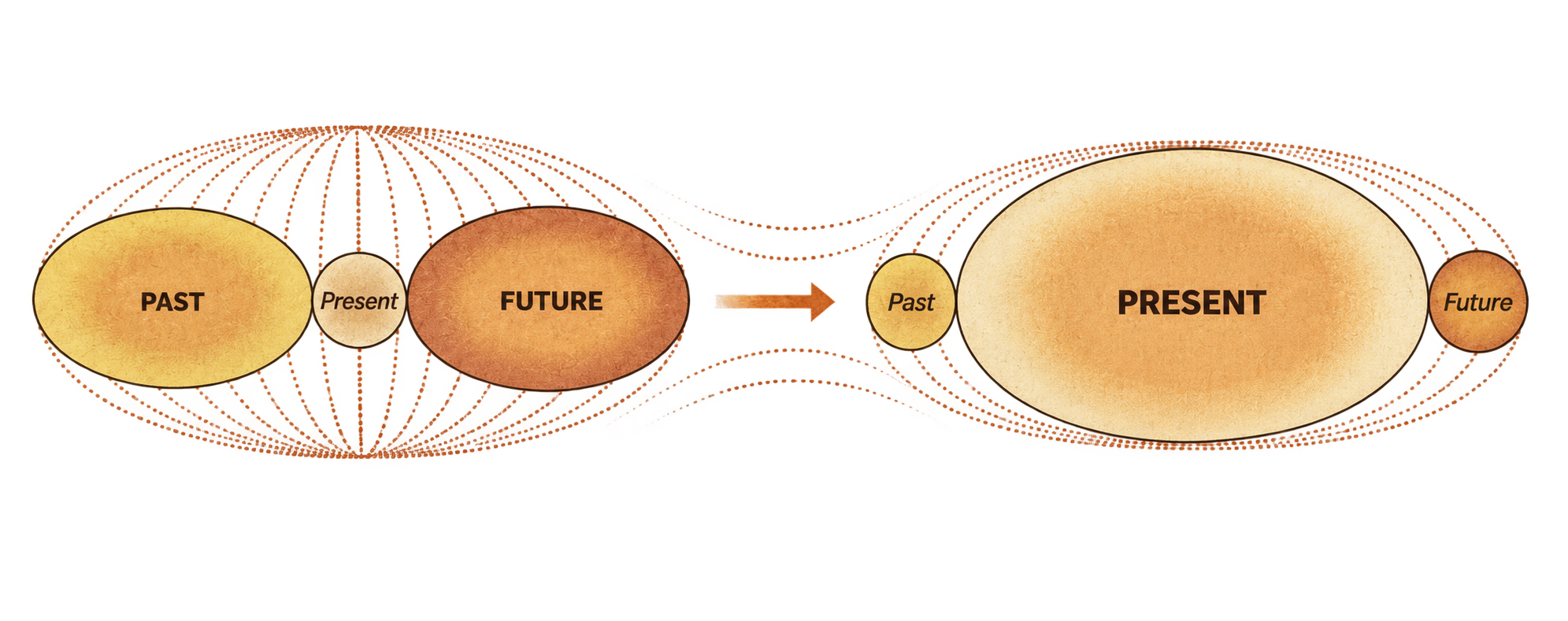
Mindfulness is the practice of paying attention to the present moment, on purpose, and without rushing to judge or fix what you notice. Or, as Jon Kabat-Zinn puts it, paying attention as if your life depended on it. Because it does.
It sounds simple, but it takes practice, because most of us spend a lot of time somewhere else: replaying the past, rehearsing the future, or half present, planning the next thing.
It is not that our mind is failing, or that we are doing anything wrong. Our minds are big, busy, problem-solving machines. They just need their attention redirected to the present moment.
In therapy, mindfulness isn't about clearing your mind or feeling calm all the time. It's a way of building a different relationship with your thoughts and feelings, one where you can notice what's happening in your body and mind without immediately being pulled into it.
It's not a stand-alone therapy so much as a thread that runs through many others. Sarsha weaves mindfulness into sessions where it's useful, as a grounding tool, a skill you can build over time and use well beyond the therapy room.